
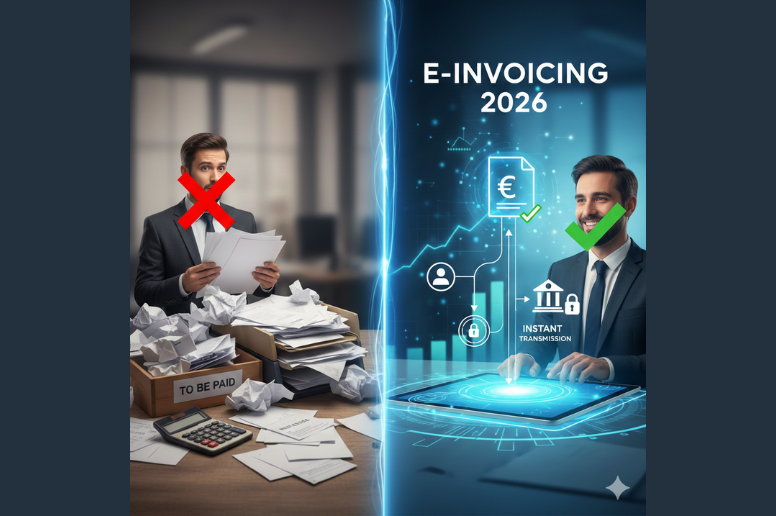
E-invoicing is becoming a legal requirement across Europe and beyond, but what exactly is it, and more importantly, when do you need to be ready?
Who has to be ready in 2026?
The year 2026 is a major milestone for tax digitalization. In France, the rollout is phased by company size, giving smaller businesses more time to adapt.
Large and Mid-sized Companies (1st September 2026) – Businesses with more than 250 employees or high annual turnovers must be able to issue e-invoices and report B2B data electronically.
All Businesses (1st September 2026) – Even if you are a freelancer or a micro-entreprise, you must be able to receive e-invoices by this date. While you might not have to send them yet, you need a compliant system to accept them from your larger suppliers.
Who can wait until 2027?
If you are a Small or Medium Enterprise (SME) or a micro-entreprise (typically fewer than 10 employees), you generally have a grace period for issuing invoices. In France, the mandatory requirement to issue e-invoices doesn’t kick in for SMEs until 1st September 2027.
However, waiting is risky. Since you must be able to receive them by 2026, most businesses will find it easier to switch their entire system over at once rather than managing a hybrid of paper and digital.
Is it just for TVA-registered businesses?
The short answer is yes, primarily. E-invoicing mandates are designed to track TVA.
The Rule – If you are subject to TVA, this concerns you.
What if my clients are TVA-registered but I’m not? If you are below the TVA threshold (eg a micro-entreprise not charging TVA), you generally do not have to issue structured e-invoices. (A non-structured e-invoice would be for example a JPG, PDF, Word doc etc).
However, if your clients are TVA-registered firms, they may eventually require digital formats to streamline their own accounting.
Why is this happening?
The primary driver is the TVA Gap – the difference between the TVA total expected by the government and the amount actually collected. By moving to e-invoicing, the state can:
- Stop Fraud – Real-time reporting makes fake invoicing nearly impossible.
- Get Accurate Data Fast – Instead of waiting for quarterly returns, the state sees transaction data instantly.
What’s the advantage for YOU?
It’s easy to see this as just more red tape, but e-invoicing also offers improvements for business owners:
Reclaim TVA Faster – Because the tax office has the data immediately, the processing of TVA refunds can be significantly accelerated.
Get Paid Quicker – E-invoices are structured data, meaning your client’s software can read and approve them automatically. This means you skip the “lost email” and “manual data entry” delays.
Always Up to Date – You have real-time visibility into your payment status – “Received,” “Rejected,” or “Paid”. This keeps your cash flow crystal clear.
Which software is compliant?
You cannot simply email a PDF and call it an e-invoice. A compliant e-invoice must be in a specific format that machines can read.
To stay compliant, you generally need to use:
- PDP (Partner Dematerialization Platforms) – Private, state-certified service providers that manage the secure transmission of invoices and reporting to the state.
- The Public Portal – In France, this is the PPF (Portail Public de Facturation), which serves as the central hub.
- Compliant Accounting Software – Some modern tools are already updating their systems to connect directly to these government hubs. One software system that is already completely compliant and free to use, even if you are not a client, is Dougs
What To Do Now?
This may be a great time to reassess your business structure.
To read up on your options, read The ABC of French Business Structures
If you prefer video, look up The ABC of Accounting
And to book a consultation, click here